
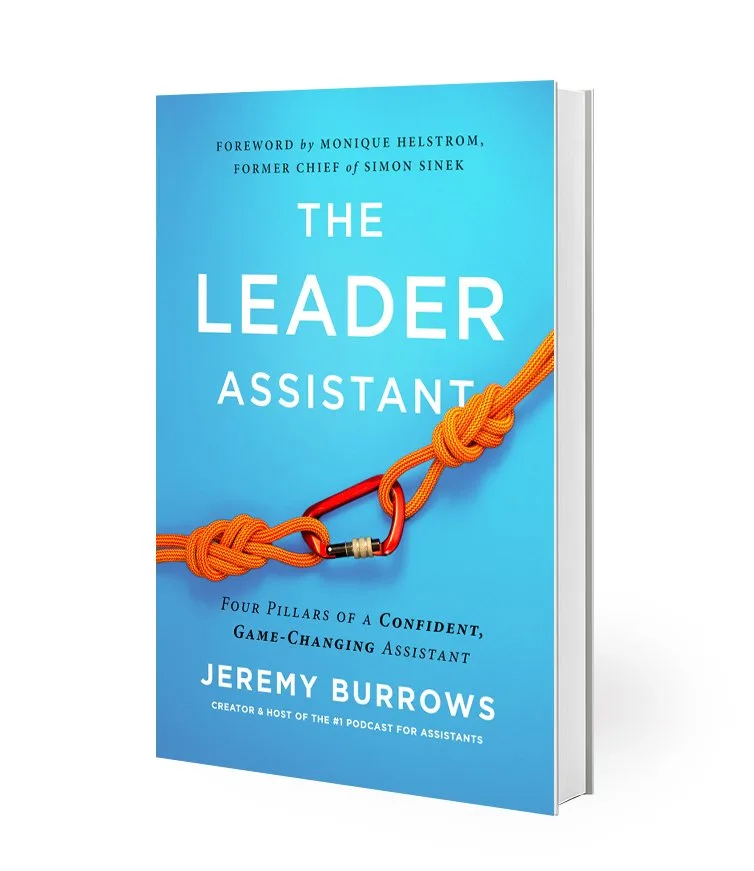
Today is release day for my new book, The Leader Assistant: Four Pillars of Confident, Game-Changing Assistant! Thank you for your support along the way!
In this episode, I share the audiobook version of Chapter 1: The Essential Characteristics. The audiobook releases later this summer, but in the meantime, you can buy the Amazon Kindle eBook version for only $0.99 (the week of June 23 ONLY) on Amazon HERE.
Leadership Quote
“Do something, but don't do everything.”
Unkown
Transcript
Read the full transcript2,950 words
Jeremy · 0:00
Today's leadership quote comes from an unknown author. Do something, but don't do everything.
Speaker 2 · 0:10
The Leader Assistant Podcast exists to encourage and challenge assistants to become confident, game-changing leader assistants. Welcome to episode 67.
Jeremy · 0:23
Thank you for being a leader. Hey friends, welcome to the special book launch episode where I'm going to share Chapter 1 from my audio book, which I am about a little more than halfway done recording. It launches later this summer, but I wanted to share Chapter 1 from the audio book to celebrate today, which is release day for the paperback, hardcover and ebook versions of the book. Thanks again for all your support. Thank you for pre-ordering, those of you who pre-ordered. But today is a big day, June 23rd, 2020, and this week is a big week. The Amazon Kindle version of the book is going to be $0.99 starting today and for the rest of this week. So go on to amazon.leaderassistant.com and buy the e-book for $0.99. Even if you've already bought the paperback or you're waiting for the audiobook, I'd really appreciate it if you bought the e-book for $0.99. I'm trying to make a splash on launch day to really help the Amazon algorithms kick in and sell a bunch of books this week, hit some rankings, trigger the algorithms so that my book shows up when people actually search for executive assistant books on Amazon. So amazon.leaderassistant.com to order the e-book for $0.99 this week only. For this special bonus episode, I'm going to share the audiobook version of Chapter 1, The Essential Characteristics. So I hope you enjoy it. Please reach out on LinkedIn or shoot me an email at hello at leaderassistant.com. And again, I appreciate your support and I appreciate you buying the e-book for $0.99 on Amazon. Chapter 1, The Essential Characteristics. A leader assistant has courage, persistence, and a good sense of humor. They stay on top of their game by staying on top of their education. They sharpen their acts by mentoring others. They're a mind reader, diplomat, psychologist, politician, strategic partner, and team player. Executive Assistant in San Diego, California. Lists of essential characteristics to embody whether you're a new assistant or a veteran are commonplace. Because everyone has their own ideas, I wanted to outline what I see as the essentials for assistance. Think of this as a warm-up and a refresher. As you work your way through the rest of the book, you'll notice many of these traits woven throughout. Proactive. Being proactive is similar to being able to anticipate, but the difference is important to understand. Being proactive means you plan ahead and prepare for something you know is going to happen. However, when you make an educated guess that something could happen and you prepare for it, you're anticipating. Here's an example of being proactive. Your executive is speaking at a conference and their presentation has some unusual requirements. You seek out the audio, video, or AV team for the event weeks in advance so you can explain your executive's needs and so the AV team has more time to prepare. You're expected to be multiple steps ahead of your executive, so don't wait for them to tell you what to do. Be proactive. Responsive. Of course, it's impossible to plan for everything, so be ready to quickly tackle problems as they arise. In scenarios where something comes up that was neither planned for nor anticipated, be willing to set aside your proactive hat and put on your responsive one. In my first year at Capacity, the artificial intelligence software company I work for, I applied for my executive to compete in a startup competition for Ashton Kutcher's venture capital firm, Sound Ventures. After a couple of interviews with them, we didn't hear anything for a few weeks, so we assumed we didn't make the cut. But five days before the event, we found out that we made the top five and that my executive was scheduled to pitch our company to Kutcher, Matthew McConaughey, Mark Benioff, CEO of Salesforce, Gary Vaynerchuk, CEO of VaynerMedia, and Melody McCloskey, CEO of StyleSeat, at South by Southwest in Austin, Texas. It was an amazing opportunity for a young startup, but we had only a few days to get ready. I scrambled to cancel or move almost every meeting that week so my executive could prepare his pitch. I booked flights, hotel rooms, and rental cars for four of our team members to go with my executive. Did I mention South by Southwest is the busiest event of the year in Austin? Most transportation and lodging options weren't available anymore. Talk about needing to quickly respond in the moment. We didn't win the competition, but our team got to go to the Snoop Dogg after party. The next time you see me at an event, remind me to tell you a funny story about that. Loyal As a leader assistant, you're committed to the organization and loyal to your executive. You prioritize tasks that come from your executive over tasks that come from someone else. Your executive is your number one priority at work and they should not question your commitment to them. For example, if I'm meeting with another team member when my executive calls me, I always excuse myself to answer the phone. If you have an executive who hasn't set clear expectations in this area, I recommend clarifying your job description with them as soon as possible. For example, if you're equally split between two or three executives, the dynamic will be different than if you're an assistant to one executive while supporting other executives as needed. Trustworthy. An executive must be able to trust you and your ability to manage confidential information. You hold the keys to their kingdom, so don't lose them. No executive wants an assistant to gossip about them at a dinner party. No board wants an assistant to share private revenue numbers with assistants at other companies. Earn the trust of your executive by maintaining confidentiality at all times. Others centered. The assistant role is not a glamorous one. If you've been an assistant for even a few weeks, you're well aware of this. Your job requires hours and hours of behind-the-scenes work, most of which no one, not even your executive, will see. If you want to be the center of attention, being an assistant isn't the career for you. Your job is to further the goals and agenda of your executive and company, not your own. We'll talk about how your goals should align with theirs later. In the workplace, pay more attention to your executive and other team members than you do to yourself. I'm not saying you shouldn't take care of yourself. In fact, paying attention to self-care is critical if you want to have the energy and ability to help others. There's a reason Pillar 4 is dedicated to self-care. I am saying try not to take it personally if your executive closes a seven-figure sales contract you played a big role in and fails to thank you when they make the big announcement in front of the entire company. Being a leader means you celebrate the success of others more than your own. Whether you need to make copies for a meeting or lead an important sales demo on behalf of your executive, be happy to help and excited to contribute. A woe-is-me attitude will not cut it. However, be careful not to let your executive abuse their authority. An effective executive will delegate challenging and interesting projects and tasks as well as necessary mundane chores. They will pay attention to the details so they don't have to bother you on a Sunday morning just to ask for information you sent them on a Friday. They will leave you alone on your days off. An executive worth keeping will be grateful that you put aside your desires to help them and the team. Sociable This characteristic is a given for all team members but especially assistants. Your executive and teams spend a lot of time with you. You are often the first contact for VIP guests, board members, investors, and potential clients. It's important to be personable, kind, and have a good sense of humor. However, being social and friendly doesn't mean you must be an extrovert to be a leader assistant. In fact, introverts make some of the best assistants. We like to sit by ourselves in a quiet office and get stuff done. Meanwhile, our extroverted team members enjoy small talk and socializing with coworkers, even if it distracts them from getting work done. Can you tell I'm letting my introverted bias seep into this section? I'm a high introvert with developed extroverted skills and my current and previous executives have been high extroverts. This works well for a strong, complimentary partnership. If you're an introvert, you might work better with an extroverted executive who knows how to respect your need for space and vice versa. But no matter your personality type, being kind to and sociable with others is a must. Organized Many people hire an assistant because they need help getting organized, but others are highly structured and simply spend too much time on the wrong tasks. For example, executives have better things to do than adding details to their calendar or entering data into a spreadsheet. Their time is better spent meeting with key staff, reading books that inspire them, working on strategic plans, and creating powerful and engaging content for the next board presentation, sales meeting, or investor update. Synthesize everything your executive throws at you into prioritized tasks and projects and execute those projects with little oversight. You won't make it long if you were hired because you have a great personality, or work really hard, but you can't keep your own car clean. Flexible I've seen assistants with many of the characteristics listed in this chapter, but they lack flexibility. Instead of being excited about and embracing change, they freeze and panic. Early on in my career, this was me. I hated last minute changes and would get dejected because all the work I put into a project seemed to be all for naught. However, I now realize pivoting can be a good thing, and the process of flexing on the fly can teach us more than staying the course. Instead of seeing work thrown out the window at the last moment as pointless, I started to view wasted work as part of the process, helping me improve at my job. Odds are your executive loves to change things up at the last minute. I think it's a job requirement for all supervisors to frequently scrap a plan and start over, or tinker with a plan right before a deadline. Rather than panicking when this happens, assistants must be ready to adapt. Assertive You can't be flexible all the time, however. There are times when pushing back is an appropriate way to help your executive keep a level head. If your executive always changes things at the last minute, they might have an unhealthy pattern that needs to be addressed before everyone burns out and loses trust in them. Leader assistants are aware of the right time to be assertive. For example, if you know a last-minute change could mean running a team into the ground or even losing some of your best team members, speak up. Tell your executive, We can't change the plan this late in the game. Or it's not worth our time and energy to shift directions. We just need to move forward. These responses aren't easy, but they show you are thinking strategically for the organization and that your response isn't just a personal preference. Focused. In today's fast-paced society where screens are everywhere and notifications are never ending, staying focused on one thing at a time is more difficult than ever. Most of the high-level executives I've worked with struggle to stay engaged with a single task for a long period of time. So one of the most crucial characteristics an assistant must possess is the ability to focus. A leader assistant can simultaneously focus on their tasks while helping their executives stay on point. Pay extra close attention to Chapter 9 if you struggle to focus. Detail Oriented. As an assistant, it's your job to notice the details. You can't wait for others to notice. If your executive is about to present to the board of directors and they have a huge piece of spinach in between their two front teeth, tell them. If a coworker posts a picture on Instagram that inadvertently included a confidential revenue chart on the wall behind them, take care of it. Be aware if your executive's flight was moved to a different departure gate or if their passport expires a week before their international trip. Don't overlook the details. Never assumes anything. As I recall the many times I missed a detail because I assumed someone else was on it, I'm reminded of a former coworker's advice. Never assume anything, Jeremy. In other words, anytime you find yourself thinking, I'm sure someone else took care of that, or I'm positive she understood what I was asking, or in the case of the million-dollar typo I'll tell you about later, I'm sure the other two team members would have caught something major if there was anything wrong. Double check your work and pay extra close attention to the details. When we assume, we miss details. Positive Attitude This is pretty straightforward, but a leader assistant is someone who has a positive attitude. It isn't always easy, but staying positive no matter what is thrown your way is a characteristic any executive would want in their assistant. Strong Communication Skills Assistants communicate with coworkers, board members, executives, other assistants, vendors, clients, potential clients, and more. Having strong verbal, nonverbal, and written communication skills is a necessity if you want to thrive as an assistant. We will discuss tactics for communication in Chapter 18. Curious You don't have to be an expert in every single topic under the sun, but effective assistants are curious. When you hear a term you don't know, look it up. When someone shows you how to do something, ask them why it's done that way. Be eager to learn and explore. Be eager to learn and explore. Curiosity not only helps you execute tasks as they come, but also helps you expand your overall knowledge. Resourceful One way to be a resourceful assistant is to figure things out on your own. But if you find yourself stuck on a problem, don't be afraid to ask for help. Leaders aren't afraid to admit they're struggling to solve a problem. Sometimes outsourcing is the quickest and best way to overcome a glacier. When a project requires expertise and a certain skill set, hire a specialist. For example, I've outsourced projects to human resource experts, lawyers, event planners, graphic designers, even carpenters. Efficient I'm always noticing how inefficient things are. I'll be in line at a fast-food restaurant and I'll tell my boys how I change things. I'll walk them through which systems are slowing things down and how I would make them better. Look for ways to cut seconds out of your work processes. Always ask yourself the question, how can I minimize wasted time and maximize productivity? Leader Assistants work quickly and efficiently. Context Aware The last essential characteristic is the ability to understand the environment you're in and adjust accordingly. In other words, Leader Assistants are context aware. When you learned how to drive a car, you thought the hard part was simply controlling the vehicle. As you mastered the art of avoiding curbs, however, you learned the real challenge of driving is making decisions based on the many variables surrounding you. Is the road slick from rain or ice? Does the semi-truck see you passing? Is that pedestrian going to step out in front of you? Decisions shouldn't be made in a vacuum. Do you embody the essentials? One of my former executives went through several assistants before he hired me. The longest any of them lasted was 18 months. One assistant was loyal but not organized. He was willing to drop anything for his executive, but he also frequently dropped the ball. Another was organized but wasn't proactive. He could keep track of all of his tasks, but he would sit around waiting for things to do. It's no wonder they didn't last long. Making a positive and powerful impact as an assistant requires embodying more than just a few of the essential characteristics. Take a look at the list again. Make an honest self-evaluation about which are strengths and which are weaknesses. And pick a few trouble spots to work on in the coming weeks. Proactive, responsive, loyal, trustworthy, others-centered, sociable, organized, flexible, assertive, focused, detail-oriented, never assumes anything, positive attitude, strong communication skills, curious, resourceful, efficient, and context-aware. Use questions like, What would it mean for me to be curious this week? Or How can I embody assertiveness today to get you thinking? Okay, now that you're caught up on the essentials of your assistant role, let's look at the characteristics that will help you change the game. I hope you enjoyed that sample from the upcoming audio book of The Leader Assistant, Four Pillars of a Confident, Game-Changing Assistant. And again, you can buy the Amazon Kindle version for only 99 cents this week only at amazon.leaderassistant.com. Talk to you soon.
Speaker 2 · 21:00
Please review our Apple Podcast. goburrows.com