
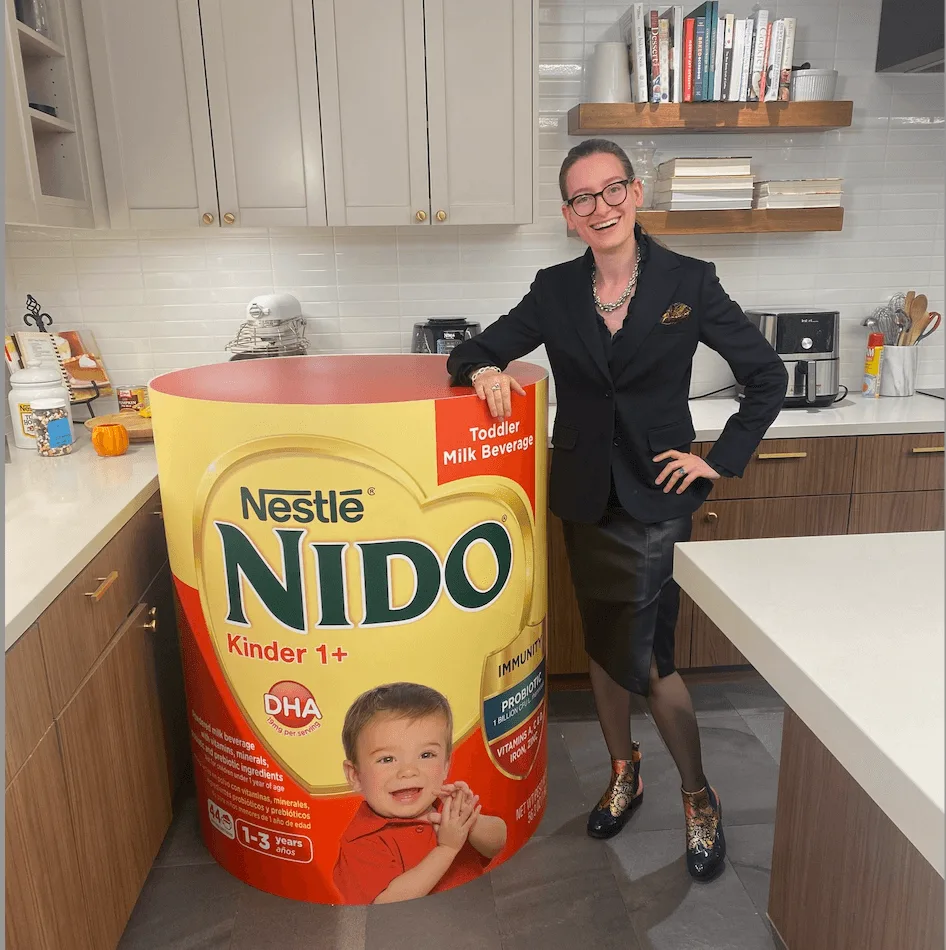
Liliya Susong is a Senior Administrative Assistant at Nestlé North America. An immigrant to the US, she has 11+ years of experience as an EA with international companies and counting - now on the US side! In this episode of The Leader Assistant Podcast, Liliya shares her journey navigating culture gaps as an immigrant to the US, communication, networking, and working with an assistant team.
Leadership Quote
“If you were stripped of your title, would people still follow you?”
About Liliya
Liliya Susong is a Senior Administrative Assistant at Nestlé North America. An immigrant to the US, she has 11+ years of experience as an EA with international companies and counting - now on the US side! Originally from Moscow, Russia, Liliya holds two Master degrees from top Moscow universities, majoring in Linguistics and International Relations. She speaks Russian, English and some German. During her college years she worked for the Ministry of Foreign Affairs of Russia, but after graduation pivoted her career to become an Executive Assistant. Over the years she has worked in international law firms (Noerr and Norton Rose Fulbright), security and cyber companies (Sfera JSC, Group-IB) and a HNWI family office. She has experience building and leading Admin teams from scratch and effectively training new hires. Some highlights of her career include:
Advocating for, leading and coordinating every step in Sfera JSC, a Russian software developer and system integrator joining the European Emergency Number Association (EENA). Sfera was the first company from Russia to join the Association and present at the EENA Conference. Taking an active part in coordinating CyberCrimeCon (annual global cybersecurity conference) to streamline processes around international guests’ travel, negotiate with the hotels and sponsors to get discounts, and save additional costs by involving volunteers. Liliya also managed the visit of Mr. Noboru Nakatani, executive director of INTERPOL's Global Complex for Innovation, to Moscow to sign a data exchange agreement.
Liliya is active in the EA community – she is a member of the global Chief of Staff Association and ASAP (American Society of Administrative Professionals), and a published author with profiz.ru - a Russian magazine for admin professionals. Liliya also volunteers as an Ambassador for MASA program, connecting the Jewish diaspora with Israel through subsidized programs for young adults. Liliya lives in Washington, DC, with her husband. In her free time she enjoys reading, baking, food photography, long hikes, and DIY renovation projects.
Episode links
Transcript
Read the full transcript5,893 words
Liliya · 0:00
Hi, I'm Liliya Susong, and my favorite leadership quote is, If you were stripped of your title, would people still follow you?
Jeremy · 0:06
Thank you.
Speaker 3 · 0:13
The Leader Assistant Podcast exists to encourage and challenge assistants to become confident, game-changing leader assistants.
Jeremy · 0:20
The Assistant Good morning, all executive assistants. Are you looking for a way to elevate your skills or earn that promotion you've been eyeing? Nova Chief of Staff's Online Certification Course provides you with the knowledge and confidence you need to stand out on the job. Whether you want to land your dream position or level up in your current role, Nova's self-paced course gives you hands-on practice doing what chiefs of staff do every day. Visit leaderassistant.com/nova to learn more and secure your spot. That's leaderassistant.com/nova. Hey friends, welcome to The Leader Assistant Podcast. It's your host Jeremy Burrows and I still am getting over my illness, but hopefully my voice is not too low or too raspy for you today, but the show must go on. So I'm excited to kick off episode 268. You can check out the show notes at leaderassistant.com/268. leaderassistant.com/268. So today I am excited to be speaking with Liliya Susong. Liliya is Senior Administrative Assistant at Nestlé North America. Liliya, thank you for joining us.
Liliya · 1:55
Thank you for having me. I appreciate that.
Jeremy · 1:58
What part of the world are you in and where are you from? Give us a little bit of the personal background.
Liliya · 2:04
Right now, I'm in Virginia. I've been all over the map for the past decade. I'm originally from Russia, Moscow. I also lived in Israel because I happened to be Jewish, and I spent about a year in Israel. For the past four years, I did not count specifically, but I relocated to the states with COVID. I actually got locked down. My partner at the time, now my husband, he was speaking at Harvard. I came to be with him and support him, and the next thing I knew, I was staying for good. Since then, I changed locations around the states about four times, and again, not counting, just going on.
Jeremy · 2:42
Nice. What part of Virginia?
Liliya · 2:46
Arlington.
Jeremy · 2:50
Good deal. Well, I was born in Virginia. That's a fact that some people know, but I moved to Kansas City, Missouri when I was one, so I basically from Kansas City, but I was born in Virginia. Yeah. First, before you jump into your career, what's your favorite thing to do when you're not working?
Liliya · 3:18
Two things. Baking. I'm a huge baker. I love baking. I love cooking. So anything in the kitchen. The kitchen is my happy place. The house at large, I'm huge about DIY renovations. All that. I will not be original if I say I like photography and traveling, and all the good things.
Jeremy · 3:37
I got to ask a question. DIY stuff, what's the project you worked on recently?
Liliya · 3:44
My favorite project, my big baby is we have a cabin in the Smoky Mountains, and I renovated it top to bottom. That included some furniture renovation, like big flipping projects, and I spent, I want to say about 40 gallons of paint alone. So my husband was saying that if he didn't move around the house fast enough, I would paint over him.
Jeremy · 4:11
Oh man, yeah, so we rehabbed our house, and we're renovating the house across the street for my parents, and my brother renovated his and my other brother renovated his. So we've done a lot of DIY YouTube videos to see how to do things, and there's certain things that I try not to do myself because I'm just like, it just doesn't fit my temperament. Like for example, laying tile is something that I'm just like, I don't know, that's one thing I'm trying to avoid learning how to do. My brother does it, so thankfully he did it for me.
Liliya · 4:44
Well, you're a good team.
Jeremy · 4:46
Yeah, exactly. Yeah. I do all the dirty demo destruction and stuff that's just-
Liliya · 4:51
Letting the stress out.
Jeremy · 4:53
Yeah, exactly. Fill the dumpster up and then he comes in and makes things pretty. So awesome. And then the other question I was going to say, what's one of your favorite things to bake?
Liliya · 5:06
Oh, that is difficult because I bake so much. Off the top of my head, probably Pavlova, the meringue and the fruit and the whipped cream and all that. And actually a fun fact, when I joined Nestlé, I discovered that one of the products that is actually in my department, in my team, it is Nestlé Lollachera Dulce de Leche, which is boiled condensed milk. Do you know the product? Yeah. I grew up with that for me and I was born in the Soviet Union. This is a childhood memory. And I did not expect to discover it stateside. When I did, I was so excited. And I started explaining to my family that growing up as a kid, there was that very special treat that you got very, very rarely because it was a pain in the butt to make it. But there is a thing which looks like it's from Tia Press. It makes little nut shells. And so then you fill those wafer nut shells with dulce de leche. And you give it to your kids as a little treat. It's like a little nut filled with dulce de leche. I adored those. I was absolutely shocked to see that Amazon actually sells those presses to make the nut shells. So I made that. I brought it into the office. I introduced everybody to the taste of my childhood. And this is an amazing little bridge, both culturally and in my kitchen.
Jeremy · 6:39
That's amazing. That's awesome. And yeah, and you work at Nestlé. That's crazy.
Liliya · 6:45
Yeah, exactly. What were the chances, right?
Jeremy · 6:49
So, okay. So tell us about your career then. How did you end up in the assistant role?
Liliya · 6:56
I do not know a single person, and correct me if you know somebody, who grew up saying, I will be an assistant. People usually grow up with a very different vision of their future. Like, I'll be a fireman, I'll be a doctor, I'll be something exciting. And I do not know anybody in our field who would say, yeah, I wanted to be an assistant and I became that. Usually, it's a very wind and path, and it's always very interesting to connect with colleagues. And explore what led them into the role. So for me, I have two majors. My first major is linguistics, and my second major is international relations. And this is where I wanted to be. I wanted to be with the Ministry of Exterior, and I wanted to be bridging those cultural gaps in a very different capacity. But my father fell ill. I had to pivot and go for a career. You know, government roles do not happen to be very lucrative in any country. So I had to make that very, very fast pivot. And I was thinking, what skills do I have and how are they transferable to a different field that can be a better fit for me and that can actually be something interesting. And this is how I stumbled into that role, which was with a German law firm and they wanted an assistant translator. And this is what I became. And, you know, the rest is history.
Jeremy · 8:23
So I'm looking at your LinkedIn. How long now have you been an assistant then?
Liliya · 8:28
Oh, my gosh. Since 2009, I'd say.
Jeremy · 8:32
Okay. Awesome. Yeah. And then how did you did you get the Nestlé job while you were living in the States? Or, you know, what was that whole process like?
Liliya · 8:46
Yeah, that was a whole big deal. When I relocated, like I mentioned, I relocated before COVID. So being locked down, I was on a different type visa and I was not eligible to work. And then with all my transitions and getting legal in the States, I was just home, DIY projects and all that. It was beautiful. But I was very willing to get back onto the market and to see how and where I can take my career here stateside. And so when I got my employment authorization and I started upgrading my resume and actually being active on LinkedIn, Nestlé found me. And that was a perfect cultural match. I'm extremely happy to be where I am. I think it's an amazing company to work for.
Jeremy · 9:37
Love it. So what are some challenges or even tips with assistance navigating the cultural differences and being an immigrant trying to get a work visa or language gaps? There's all those things. I mean, we could probably talk about all these topics all day. But I even had a couple of assistants reach out on our community recently and they said, Hey, do you know any companies that are hiring that will sponsor a visa, for example? And so anyway, just talk to us about that process and your story and just share whatever you want to share. It's just fascinating. Your story is fascinating. And I just would love to hear about it.
Liliya · 10:27
Well, you know, first things first to the people who are reaching to you to ask about companies that will sponsor a visa. I would say that is pretty rare because when you go through a bureaucratic process, it is no small feat. And for the company to do that for somebody, you need to be in a very, very highly skilled, highly unique and highly valuable role for the company to want to invest. Having said that, I don't think it's impossible, but I think the right transition path would be to work for a global company in your country of origin and then see if you can transition with the company, with the role, build those relationships, network, make everybody you can aware that this is something that you want. And then possibly that can happen. This is not how it happened for me. My husband is American, so my relocation was through a spouse visa and I'm still in the process of sorting out the intricacies of American bureaucracy. You would think coming from Russia, you are very well familiar with bureaucracy, but American bureaucracy is a whole different beast. So I always say that, you know, if you're an immigrant and you're job hunting in the States, regardless of your role, it can be an EA role, it can be any other role, but I think it's only fair if you bring up the concept of immigration, how it changed you personally, what you have learned from this personal journey, because immigration means that you are very brave, you are stepping out of your comfort zone daily. It means that you are very willing to learn and you're learning on your feet, because you are completely immersed, like you're dropped in a different culture. And you have to adapt very fast. And being able to adapt fast is the essence of the EA role, right? Being able to deal with a lot of bureaucratic, complex processes is the essence of the EA role. Being able to stand up for yourself and politely push back if you need to is the essence of the EA role. Being that person who leads not just for people around you, but also for yourself, again, is completely in line with the EA role. And so managing change, managing bureaucracy, pushing your own limits daily, this is definitely something that enhances your resume if you're an immigrant. I think a lot of people are kind of shy in thinking that, hey, I'm an immigrant, what do I actually bring to the party? I'm different. You're different. It's OK. It's actually great. You can make it a very strong plus point.
Speaker 4 · 13:14
Are you ready to elevate your career in 2024? I'm Maggie Olson, founder of Nova Chief of Staff Certification, the first of its kind online course for aspiring and existing Chiefs of Staff. With curriculum taken directly from on-the-job responsibilities, Nova's self-paced learning modules provides you with hands-on experience so you can feel competent and confident moving into a Chief of Staff style role. It's the perfect next step for executive assistants. Head to leaderassistant.com/nova to learn more, grab the syllabus, and enroll today.
Jeremy · 13:46
Thank you. That's great. It's well-said. And I think that even just the tip about from encouraging people who are asking about companies to sponsor visas, say, hey, work for a global company that's in your home country and go from there. That's a really good tip that I've never really thought of. So thanks for sharing that too.
Liliya · 14:14
You're very welcome. And I will be happy to talk to anybody who is in the immigration process or willing to speak about that kind of experience. Because I do think that being that voice for the community, our EA community, that matters. I've talked to a few people who are in this process, in this journey from different countries. We're all navigated differently, but we do build a very similar skill set. So I think there is efficiencies to be gained.
Jeremy · 14:41
Yeah, definitely. And for those listening, I will put Liliya's linked in URL in the show notes at leaderassistant.com/268leaderassistant.com/ 268. So you can check out her LinkedIn profile and reach out and say hi.
Liliya · 15:01
I'm always open to connections.
Jeremy · 15:03
Awesome. So let's talk a little bit about that, that culture gap and communication and the language differences. How many languages do you speak?
Liliya · 15:15
Oh my gosh. I'll be honest. Russian native, English fluent, fluent enough. The rest are very well-forgotten. I used to speak pretty fluent German. I used to speak various degrees of Hebrew and Serbian and French. But I would not want to be bashful and say I speak those languages. I really only speak two and I can maybe communicate in German a little bit.
Jeremy · 15:45
Nice. So then how have you in your career bridged that gap, the cultural gaps, and then specifically Russia and USA, but whether it's with networking, communication, or anything, even just the strategic partnership with your executives. So talk to us about your journey through bridging those gaps.
Liliya · 16:12
Immodestly, I will say, I think I'm very uniquely positioned because those two degrees of mind that I mentioned in linguistics and in international relations, they do equip you very well for navigating a different culture. I started learning English when I was four, so I am a very fluent, I very rarely have trouble explaining myself, but I'm also human. So yes, when I'm very tired, when I'm at work and I have a hundred things running through my mind, an avalanche of emails coming into my inbox, people wanting things from me, I may have a brain freeze moment. We all have that regardless of the language we speak, but I think people who do not speak the languages needed, they get a little self-conscious about it and I do too. I know those words. Why can I not remember them now? But you always manage to explain yourself, of course. Again, this is just something that you have to roll with. It's very, very nice if your company recognizes that we're all from different backgrounds, and you need to give your international colleagues a minute to compose themselves, or help them find that word that they're roping for, or just be nice and smile and signal in a human way that we are okay, we are communicating, nobody's getting frustrated at you for not being able to recall something momentarily. Again, having said that, what helps to bridge the cultural gap is, of course, reading and watching a lot of videos, and those might be any daily YouTube videos, any shows that reflect the current culture. And sometimes, again, it might be just a silly show, which is, you know, nothing much. And you would maybe not be proud to mention that I'm watching this, but this, whatever this is, has the current people, like, it was shot several months ago, not years ago. So you will be picking up on the current accent, on the current words, on the current way of communication, and you will be seeing what's normal. You will be learning a lot about the culture. So things that I have learned growing up with the language, learning the language, I think for a lot of people just watching daily news and watching some, you know, videos and some podcasts that can be very helpful.
Jeremy · 18:57
That's really interesting. Yeah. What's maybe one of the key shows, if you're willing to admit it, what's one of the key shows that you watched early in your process of trying to figure out? Or maybe you still do.
Liliya · 19:11
Look, early in the process was in the Soviet Union. Nobody watched shows then, right? That was a very different story. You need to remember that I grew up behind the Iron Curtain. And I actually owe it to my parents that in an astounding burst of creativity, absolutely unexplainably, people who grew up in the Soviet Union and did not speak any foreign languages, did not see any reason for, like, why would you learn a foreign language? It's a very, very closed society, but they decided that the kids should be learning English. And when I was four, they got me a tutor, and I do not remember myself not speaking English. So that's just me. But speaking of shows, you know, funny shows, like you said, if I'm not afraid to admit it, Queer Eye, you get all the current language, you get a very diverse cast of characters, something like that. Or, you know, if you are a little more confident and can stomach a different degree of linguistic proficiency, maybe something like Formula One, you know, a lot of topics being discussed, because a lot of things around leadership and competition, which are, in a queer way, work related. So why not? Pretty much anything can be your helping stepping stone in that journey.
Jeremy · 20:45
Nice. So what about working with your executives? So tell us about maybe if you have a story or a challenge or a success story or all of the above, but basically that dynamic relationship between you, the assistant, and your executive and you're trying to build the strategic partnership and you've kind of maybe butted heads or had a misunderstanding and how did you work through that? Anything like that, talk to us through that journey as well.
Liliya · 21:20
You know, I will take a step back from executive and take it to the very first stepping stone, the interview process. Because for me, this is where the fundamental difference lies. And here again, I'm speaking as a private individual, just about my personal experience of somebody who grew up in the Soviet Union slash Russia and then relegated to the US. But the cultural differences become very, very apparent when you start interviewing for the job. Because America is a very informal culture. You start with a small talk. Hey, how are you? You know, what's the weather like? Oh, I see you have a cute cat. Oh, you know, this is a very, very lovely wallpaper. And I know a lot of people from post-Soviet space, and I'm very intentionally saying post-Soviet, because it's not just Russia, it's all the countries of the former Soviet bloc, who grew up in a very, very stifling culture where you do not do small talk. You know, Russians are notorious for not smiling, for not being those happy, shiny people. And when you come from that background and the interviewer is being all nice and asking you personal questions about your family, how's your family? Why are you asking me about my family? I don't know you. This is the reflex that sort of kicks in automatically. This is your factory setting, if you will. And you need to be very, very mindful to overcome the factory setting and to be like, OK, I am in my case, I'm in America. I'm a smiley person and I do small talk and I discuss weather and I'm happy. And then when we do all that, we very gradually transition into talking about business. It does not make me less professional. It actually signals to the recruiter that I'm fine. I can communicate. I can fit in with the company culture. But what a lot of people, a lot of Russian people that I personally know do, they are so buttoned up. It's so hard to relax and have a conversation. And it's a human interaction. And recruiters talk to a lot of people and they sense that unease immediately. And that may impact the first impression that you're making. You know, this is somebody who cannot communicate well. They can communicate well. They're just very shy and they maybe don't know how to. But it can be a deal breaker. So this is something that I would advise to learn very early in the job hunting process. How is it done here? How can I adjust my personal style? And then hopefully when the interview is successfully over and you're in the company and you're building relationships within, again, your former factory settings that you carry with you may impact how you communicate, may impact how you lead or follow. Again, America is a very collaborative culture, generally. Regardless of the company, I would say that Americans are good team players and they want to have that feedback from every person on the team and they want to align with everybody on the team. Russia is very authoritarian. Russians do not do that. The boss has an opinion, everybody else follows. You have to be very, very brave to challenge that. And challenging somebody, especially if that somebody is in a higher position of power, is never or rarely ever welcome. In America, it's mostly fine. You actually earn points for doing that because you're thinking about the business and you're challenging to bring more efficiency in the process. Or you're challenging it because as an assistant, you see that there is a watch out and you need to make everybody aware of it. So where Russians will tend to blindly follow or just execute, in America, it's totally okay to say, hey, let's think about it. What I feel is this. And I feel strongly about it because I've had similar experiences when things did not quite work out as planned. And this is what I suggest and how we can turn this around and make it successful. Just the line on what success looks like. So this is very, very different. And again, in conjunction with that, I would say that because Russian culture is being so harsh, if you will, you have this inherent mistrust of why is everybody so nice to me? Why is everybody so friendly? Can I trust those people? You know, it's a funny catch-22 in your mind. It's like, how do I handle that? Are they really as nice as they seem? And back in Russia, I know a lot of people saying, well, Americans always smile and this is insincere. And my point has always been, and especially with me becoming an American, Americans mean it. They do smile. They are nice, polite people. Nothing wrong with that. But again, this is just a little something that works differently in the origin culture and something that you have to be very mindful of. And I think that it's very helpful when you build a relationship with your executive if we speak about the executive assistant role. If you make your executive aware of why you may react differently to certain things, why you may be a little shy to express yourself and you need a little encouragement, or why you are constantly double checking, are we okay? Are we really okay? And it helps a lot if you just have those touch bases constantly. And you make sure that you are on the same page. They understand where you come from, you understand where they come from, and you find that golden middle in how you communicate.
Jeremy · 27:37
Yeah, that's well said. So when it comes to interacting with fellow assistants, I'm assuming there are a lot of assistants at Nestlé. Nestlé is a big company.
Liliya · 27:51
That's correct.
Jeremy · 27:52
So you work with a team. What is, how has that worked? What are some tips for working with a large assistant team? You know, interacting and supporting each other, as you also support your executives. Just talk to us about working on a team of assistants. Because a lot of assistants, you know, like me, I work, I'm the only assistant at my organization. But I spoke with a team of assistants in Florida yesterday, and they had, I think it was like, you know, 90 something assistants at their organization. And so I love to hear from other people that work in team, in large team of assistants and just kind of hear about that dynamic.
Liliya · 28:42
I feel that you are both in a very good position, being the sole assistant in your own competition. And also in a somewhat disadvantages position, because you don't have peers to talk to. And I feel that you compensate a lot through the podcast, because you have built an amazing community and an amazing network. And I'm a huge fan of building a network wherever you are. And regardless of how many assistants there are in your company, I think that for an EA, it's not good if you allow yourself to be siloed. Because cross-pollination is a great thing. You learn a lot from your colleagues. You learn how they deal with similar situations, keeping confidentiality in mind, of course. But you can always learn from somebody else. You can always learn a more efficient way to do something, or you can brainstorm and create a solution together. So part of why I love being at Nestlé is that we have a robust EA community, and you can always come to your peer or senior, and you can always ask a question, or you can always find a mentor, or you can be that mentor for somebody else. And I think that it propels you forward so much faster, and it gives you so much comfort that you're not alone. You actually have people that you can talk to. And again, speaking of confidentiality, sometimes certain things you cannot ask outside the organization. But if you're inside, that's an advantage. You can actually share more information than you would normally share with an outside world.
Jeremy · 30:33
And what was the... Could you tell us the story of a challenge that you've had with colleagues or with being in a team or maybe at a former organization? Maybe what's one of the struggles that you've had in your assistant career? It could be related to working with a team, but it could also just be a challenge in your career as an assistant, one of the hardest things about your assistant role.
Liliya · 31:01
I want to try and make it culture gap related again, so not so much of a challenge. Feel free to edit this out, of course. One of my favorite movie quotes is a quote from The Race, the movie about Jesse Owens. Do you recall that one?
Jeremy · 31:26
I've seen it.
Liliya · 31:27
He's the black American runner in the Olympics. Watch it. Just my personal recommendation. Great movie. Really, really great movie based on real events, real story. Very powerful. So him being a black American, he was just working in cotton fields, picking cotton. And then he gets discovered and his coach gives him that very zesty pep talk about, hey, you know, you need to work very hard and you need to be ready for this and that. And we will practice so much. And as your coach, I'm telling you that this is extremely hard work and 100% commitment. And Jesse listens to him. And the coach concludes by saying, are you ready to work hard? Can you work hard? And Jesse goes, sir, I've been picking cotton for so many years. So sometimes I feel that way when I talk to my peers here in the States, just because the culture back in Russia was so different and the expectations were so different. So I felt that when I started interviewing in the States, you know, if you look at my LinkedIn, if you look at my resume, a lot of my roles say executive personal assistant, because one of the bigger differences on the market is that the assistants in Russia usually get this executive role with a lot of personal support, and this is not really negotiable, and this is just how the market is. And the degree, the percentage of the tasks that you get in personal and business may vary, but almost inevitably an assistant in Russia will be tasked with some personal things. So in my experience, in one and the same role, when I was supporting the same founder of the company, within one business day, I could be managing something like getting the head of Interpol into Russia to sign an agreement. And then on the side in the evening, I would be driving to the airport to pick up the cat that my executive decided to purchase on the spur of the moment. And then I would be responsible for making sure that the cat actually has cat food and, you know, cat beds and the scratching posts and that the housekeeper knows how to deal with that. So you balance a lot of different things in one in the same role. And when you come to America, where I feel that mostly, and again, I know that this is not completely the case. I know that some people have roles which have that mix of everything. But mostly, if you're hired as an executive assistant, that means business only.
Jeremy · 34:35
Yeah, especially in larger companies.
Liliya · 34:40
Exactly. You just you do not do any personal tasks. This is not an expectation. And so when I was interviewing, I was feeling a lot of unease, not really push back to me as a candidate, but a lot of unease on the part of the companies where they would be like, yeah, but you're a personal assistant. And I'm like, no, yes and no. I'm not just that. I actually am a business assistant and executive assistant in the first place. And I have led teams and I have hired people and I have been a chief of staff. And yes, on the side, I have also juggled personal matters, which does not make me any less efficient at the business part of my job. But somehow people just could not fit it into their heads that this is the way it works in a different market. And I got so many questions about that. And several times when I was declined a role, and I would reach out to get earnest feedback and ask what's happening. I'm not understanding why we seem like a good fit. I respect the choice of a stronger candidate if you have found one, but I want to know how I can be better. And a lot of times I would get this, you know, we were concerned that you were a personal assistant, and that would be that ultimate facepalm situation for me.
Jeremy · 36:09
Yeah, yeah. Yeah, that's yeah, because I've been an executive slash personal assistant my whole career pretty much, but that's because I'm support the CEO, and it's a more of a startup smaller organization environment. But I also enjoy doing the personal side as well, because I think that my executive has one life and I manage their one life and manage their most valuable asset, which is their time in their personal and professional life. And so their time and energy. So, yeah, but I've definitely heard of that before where it's like, you know, I talked to assistants in Europe and they call them PAs. And but but they're actually executive assistants. It's just they this is a different exactly.
Liliya · 36:58
And my my my response to the companies that I interviewed with and to people I communicate with was always, look, regardless of how you see my title, this is the same skill set. You're managing a project. It's just that your project happens to be your executive. Like you just said, you're managing time, the most valuable resource. And however you manage that in whichever capacity, personal or business, your skills will remain the same. You need to be very organized. You need to be able to track multiple concurrent processes. You need to be able to manage teams. You need to be able to lead. You need to be able to build that trust. You need to be able to keep things confidential and recognize which is confidential without your boss explicitly telling you things. A lot of similarity in whichever role, if you will, whichever facet of the same role you're in.
Jeremy · 37:56
Yeah. Well said. Well, Liliya, thank you so much for sharing your story. We could talk a lot more, but I want to respect your time, and I appreciate, you know, your willingness to share your LinkedIn so that people can reach out and connect with you offline. And yeah, it's a fascinating story and best of luck to you and your career. And hopefully we can connect in person someday. But, you know, I'm going to put you on the spot at the end of this episode. I want to ask you if you'd be willing to say a quick word in your native language in Russian for the guests. Is that OK? Would you be willing to do something?
Liliya · 38:45
Yeah, absolutely. I mean, this is funny. I do not get asked to speak Russian in my role.
Jeremy · 38:54
Oh, well, there you go. There you go. Something simple like thanks for listening to the podcast. Keep leading well, assistants of the world. I've still got the COVID fog. I'm still a little healing up. You say what you want to say, but I would love for you to wrap up the conversation with something quick.
Liliya · 39:23
Okay. Thank you for being with me this evening, Jeremy. I'm very pleased to be here on The Leader Assistant Podcast.
Jeremy · 39:36
Beautiful. Now tell us what you said.
Liliya · 39:41
Thank the audience for being on the podcast with you and myself, and wish them good luck, regardless of where they are in their journey and where they want to be.
Jeremy · 39:51
Love it. That's awesome, Liliya. Thank you so much. And again, to reach out to Liliya and say hi and connect with her, you can go to leaderassistant.com/268, leaderassistant.com/268. Thank you again for being on the show. Thank you, everyone, for listening. Keep leading well, friends. And yeah, we appreciate you.
Liliya · 40:24
Please review on Apple Podcasts.